
The Legacy of Waqf in Islam: From the Well of Rumah to Modern Endowment Projects
Throughout Islamic civilisation, the institution of Waqf (Endowment) has been one of the most influential mechanisms for cultivating social welfare, empowering communities, and sustaining religious life. Its roots stretch back to the era of Prophet Muhammad ﷺ, when early Muslims established charitable endowments to serve public needs. Among the most remarkable examples that illustrate the spirit and power of Waqf is the historic story of the Well of Rumah in Madinah, purchased and endowed by Uthman ibn Affan رضي الله عنه, the third Caliph of Islam. From this foundational act to the sophisticated endowment projects of the modern era, the concept of Waqf continues to play a pivotal role in supporting communities across the Muslim world.
The Well of Rumah: A Foundational Moment in the History of Waqf
During the lifetime of the Prophet Muhammad ﷺ, the city of Madinah faced severe water scarcity; most of the wells began drying up, except for Bi’r Rumah (the Well of Rumah). This well, however, was privately owned and its water was sold at a cost that made access difficult for many Muslims. Recognising the hardship, the Prophet ﷺ made a public call recorded in Jami‘ at-Tirmidhi:
“Who will purchase the Well of Rumah and place his bucket alongside the buckets of the Muslims, in exchange for better than that in Paradise?”
Inspired by this noble appeal, Uthman ibn Affan رضي الله عنه purchased the well and devoted it as Waqf Lillahi Ta‘ala—an endowment purely for the sake of Allah—making its water free for all. His act became a landmark moment in Islamic history, demonstrating how charitable endowments could solve urgent social needs while earning everlasting reward.
What is remarkable is not only the historical significance of this endowment but its continued impact into the modern age. Over time, the Waqf of Uthman expanded and developed:
The surrounding land was cultivated with more than 15,000 palm trees, producing dates for distribution among the poor.
Revenues from the date harvest were placed into an account under the name “Uthman ibn Affan” and allocated to charitable projects.
Profits have been reinvested into major initiatives, including the construction of a hotel in Madinah aimed at serving pilgrims, with the income dedicated entirely to charitable causes.
The Waqf of the Well of Rumah stands today not only as a historical reminder of the generosity of the Sahabah but as a living example of a sustainable, evolving system of charity that continues to benefit generations.
The Abraj al-Bait Endowment: A Modern Expression of Islamic Philanthropy
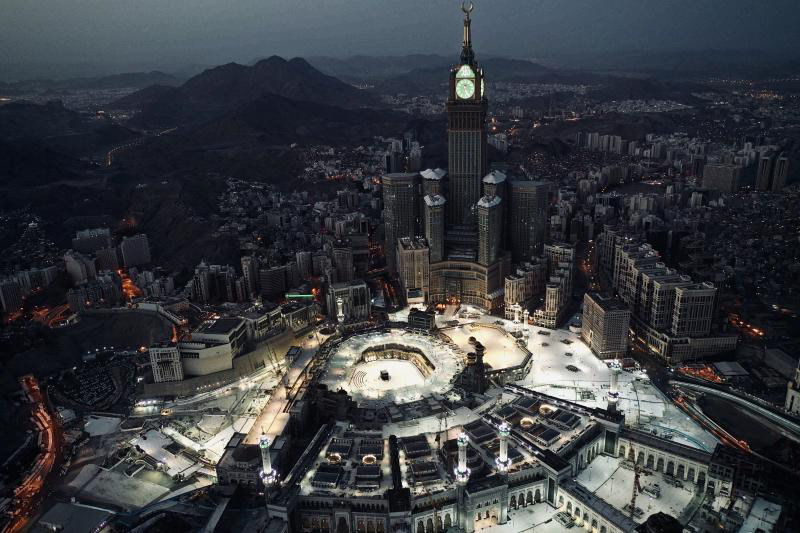
In the contemporary Muslim world, the concept of Waqf has taken new forms, adapting to urban development, population growth, and the needs of millions of pilgrims. One of the most intriguing modern examples is the Abraj al-Bait complex in Makkah—commonly known as the Makkah Royal Clock Tower—a towering landmark overlooking the Masjid al-Haram.
Completed in 2012, this complex of seven skyscrapers forms part of the massive King Abdul-Aziz Endowment Project, one of the world’s largest and most ambitious charitable developments. Costing over $15 billion, the project aims to expand and support the infrastructure of Makkah in order to serve the ever-increasing number of pilgrims performing Hajj and Umrah.
Many question the scale and function of such an immense structure—yet the answer lies plainly in the three Arabic words inscribed on the massive clock face:
“Waqf lil-Haramain Ash-Sharifain”
(Endowment for the Two Holy Mosques – Makkah and Madinah).
“Waqf lil-Haramain Ash-Sharifain”
(Endowment for the Two Holy Mosques – Makkah and Madinah).
This inscription signals that the revenue generated from the towers—hotels, residences, commercial space, and facilities—is allocated for the development, maintenance, and long-term sustainability of the Haramain. In essence, the complex stands as a modern Waqf project, using contemporary architecture, commerce, and investment to fulfil classical Islamic principles of charitable service.
The Abraj al-Bait endowment demonstrates how Waqf today can operate on an unprecedented scale, offering a blueprint for large Muslim-majority cities seeking to combine development with social good.
The Enduring Purpose and Wisdom of Waqf
The evolution of Waqf—from a single well in Madinah to global development projects—reflects its deep and timeless wisdom:
1. Enhancing Social Welfare
Waqf institutions historically funded mosques, schools, hospitals, libraries, and public utilities. Their primary objective was to uplift communities by providing services free of charge or at minimal cost.
2. Promoting Financial Independence
One of the greatest strengths of Waqf is its sustainability. Unlike one-off charity, a well-managed endowment generates long-term benefits without requiring continuous external funding.
3. Empowering the Muslim Community
The Waqf system created a parallel civil society throughout Islamic history—an independent financial ecosystem that supported education, healthcare, infrastructure, and intellectual life. It reduced reliance on state resources and encouraged community-driven progress.
4. Ensuring Perpetual Reward
The Prophet ﷺ identified continuous charity (Sadaqah Jariyah) as one of the deeds whose reward continues even after a person passes away. Waqf stands as one of the clearest embodiments of this principle.
A Call to Revive and Develop Waqf Projects Worldwide
Today, as the Muslim world faces economic challenges, humanitarian needs, and educational gaps, the revival of effective Waqf initiatives can play a transformative role. Whether through endowing property, establishing revenue-generating ventures, or creating digital endowments, Muslims have the opportunity to build sustainable projects that serve their communities for generations—just as Uthman ibn Affan’s Waqf still serves Madinah today.
The examples of the Well of Rumah and Abraj al-Bait remind us that Waqf is not merely a historical concept but a living institution, capable of innovation and expansion. Its legacy encourages contemporary Muslim organisations, scholars, and communities to invest in long-term structures that cultivate self-sufficiency, nurture spiritual growth, and provide social support across the globe.
Reviving Waqf is not simply an administrative task—it is a revival of a Prophetic vision: a vision of a community supported by charity, driven by generosity, and anchored in service to Allah and His creation.